Thursday, July 25, 2013

The Gorget

The last vestige of knightly armour, this decorative piece of metal was suspended around the neck of officers in the 18th century and early 19th centuries.   Originally, gorgets were a metal or stiff leather collar intended to protect the throat and neck. In fact, the term is derived from the French word for throat.  In the 18th century, the size of the gorget diminished as it became a piece of adornment for the uniform -- another sign of the rank of an officer. 

 
By the 18th century, the gorget shrank to a small piece of crescent shaped metal.  Suspension around the neck was by chain or ribbon. 

Colonel George Washington of the Virginia Regiment. 

As the examples below demonstrate, the gorget bore arms distinctive to the nation or monarch of the officer. Often, regimental numbers or symbols were etched on the gorget for that distinctive flair.   18th and 19th century gorgets are found in brass, gilded brass, silver and brass or silver with enamel.  As with officer's swords of the time, the gorget was as ornate as the officer could afford. 

 French gorget

British gorget

British gorget

French Napoleonic Gorget

Dutch gorget

Hessian gorget

The gorget made its way into the new world as a trade item.  Europeans exchanged gorgets with Native Americans for pelts and other goods.  


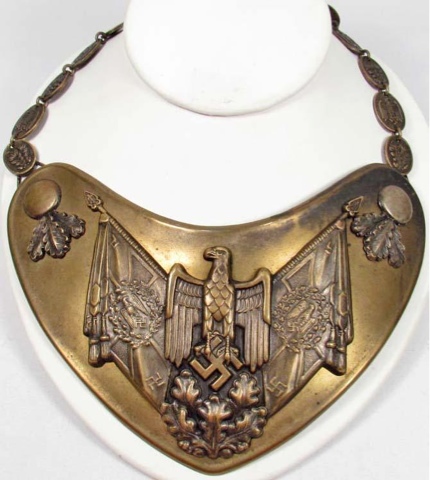
By the 1830s, most of the world's military ceased wearing the gorget.  However, it's use is seen in the 20th century -- most notably by the German military. 

Imperial German gorget

German WWII military police gorget

German Reich Labor gorget

German WWII standard bearer gorget

I've always considered the gorget an interesting proposition for collecting, but have not entered the field. With so many variations, and with relative ease of display, a collector could assemble quite a large and impressive collection. German WWII gorgets are easily found in the market and at a varied price range. As with everything German WWII, non-military items are the most affordable with SS items garnering the highest prices.  I have not encounter many 18th or 19th century gorgets on the market.  The few that I have seen bore significant price tags.  Due to the popularity of reenacting, gorgets have been reproduced. The reproductions are fairly easily to spot, but the buyer should beware of false aging and other faking techniques. 


Wednesday, July 17, 2013

The British 1796 Heavy Cavalry Sword

As I have stated before, heavy cavalry during the 18th and 19th centuries played a specific role on the battlefield.  Big men mounted on big horses wielding big swords.   


In 1796, the British would deviate from arming the King's heavy cavalryman with a long, relatively narrow, spear pointed sword.  Rather, the King's Board of Ordinance adopted a long, straight, wide bladed, hatchet point sword for heavy cavalry.   This sword is known as the pattern 1796 heavy cavalry sword. 


The sword is also known as a disk hilt sword and is derived from the Austrian model 1769 pallasch.  It is approximately 35 inches long with the blade bearing one fuller and being of the backsword type (with the spine being unedged and flat).  The iron disk hilt is somewhat crude looking and has a single knuckle bow and has two languets protruding down the blade. I've heard the purpose of languets to be to either trap and break an opponent's blade or to hold the sword securely in the scabbard.    I'm not positive of the real function of the languet, but this sword is not intended for fencing or finesse swordplay.  It is for hacking, pure and simple.  The hilt has an iron backstrap that incorporates two "ears" which are folded down and secure the grip. Thr grip is wood wrapped with cord and covered with leather. 


The sword depicted to this point is the troopers' model.  Regulations required that officers have two swords.  The dress pattern, also known as a boat shell hilt:


and the undress pattern,also known as a ladder back due to decorative cut outs in the knucklebow. 


1796 heavy troopers' swords are found with period armoury and field modifications.  The hatchet point is often found ground down to a spear point.  This was done reportedly prior to Waterloo to render the sword more of a thrust weapon so that troopers would stand a better chance hen facing Napoleon's armored cuirassiers.   Also, examples are found with the inside portion of the disk ground away (for comfort when the sword is worn on the side and to prevent wear on the uniform) and with the languets removed (because quite frankly they appear to be useless).


The 1796 heavy cavalry sword is a brute of a weapon.   Fans of Bernard Cornwell's British Napoleonic rifle officer, Richard Sharp, will remember that he carries a 1796 heavy cavalry troopers' sword at his side.  Having owned a few of these beasts over the years, I think it highly doubtful that any foot officer would carry such a weapon. It is far too long to walk around with at your side and certainly too long and heavy to fight with on foot. 

These swords command high prices on the market due to popularity and the relatively few examples available.   The British simply did not have that many heavy cavalry regiments and, therefore, fewer heavy cavalry swords.  Officer's undress examples and regimentally marked swords bring the highest prices. Beware of faked regimental designations on troopers' swords. Also, the sword, both officers' and troopers' models have been reproduced. Look for British cutler names, such as Gill, Wooley & Deakin, Reddell, Bates, Osborn & Gunby and Osbourne, stamped on the spine of he blade  as well as inspector's stamps on blades.


 Inspector's stamps will be a crown with a number underneath.  Regimental designations are founded stamped or etched typically on the guard or knucklebow and on the top side of the scabbard.  They will appear as a regimental abbreviation with a troop letter and rack number for the sword. for example:   

3d DG
 B/32

meaning that the sword, or scabbard, was issued to Troop B of 3rd Dragoon Guards and numbered 32.  The designation form depicted above is known in the collecting world as the British fraction.  The letters "YC" if found in the British fraction stand for yeomanry (or volunteer) cavalry.  A sword ith these markings, although unit identified, will not garner as high of a price as one designated to a regular army regiment, because the sword likely never left the British Isles during its service life.   Do not be concerned if the regimental or inspection marks differ between sword and scabbard. When the swords were placed into storage or decommissioned, regimental armourers often mismatched swords and scabbards. 

Finally,  make sure that what you are buying is a British sword and not the Austrian predecessor or a later Austrian sword.  The Austrian 1824 heavy cavalry pallasch, shown below, looks quite similar to the British 1796 heavy cavalry sword. 


The British 1796 heavy cavalry sword is an ugly weapon. However, the weapon has mystique. I am fortunate to have had a few in my collection. 

Note:  The photos used are not of swords that I own or have owned. Rather they are examples commonly found on the Internet in the public domain. 

Friday, July 5, 2013

The Sturmgewehr 44


Look familiar? Those interested in modern arms may think that this weapon is an early Soviet Ak-47.  This is the German Sturmgewehr 44.   The literal translation means "storm rifle," and is one of the worlds first fully automatic, mass produced assault rifles.  

STG44 development  commenced in 1942 as a result of Operation Barbarossa -- the German invasion of the Soviet Union.   The workhorse of the German army, the bolt action Kar 98 rifle, was no match for the large number of semi and fully automatic Soviet infantry weapons.  While German NCOs and select troops carried a variety of sub machine guns, such as the Erma and MP40, these weapons fired a 9mm pistol round that lacked the range and firepower of a larger rifle round. Hence the STG44 --the rapid fire capability of a sub machine gun with the range and punch of a rifle. 

German WWII wartime production has always interested me.  Infighting in the highly bureaucratic German government caused Hitler to twice suspend production of the STG44.  Hitler was obsessed with secret weapons and weapons of massive size.  Rather than produce weapons and materials that were simple, relatively inexpensive and quickly manufactured (thus received sooner in the field by the troops), Hitler directed his armament developers to produce the weapons at he believed would instill such fear in the Allies that they would be forced to seek peace.    Thankfully, and due to Hitler, the STG44 did not reach the hands of German troops early enough in the war to turn the tide.  

Many weapons throughout history have had accessories. The STG44 is no exception, but it has one of the strangest accessories ever produced.   Enter the kummlauf -- literally "curved barrel."  The kummlauf is a bent barrel extension that could be affixed to the STG44.  It's purpose was to allow the user to shoot around corners or over the sides of armored personnel carriers without being exposed to counter fire.  A version was also made for tanks.  The kummlauf came with dual sports mirrors and in a variety of colors.   Kidding -- but it did have a mirror with which to see around corners. 


While the STG44 did not alter the course of the war, it did have an impact in the field and earned  the attention of Germany's adversaries, specifically the Soviets.  The STG44's descendent,the Russian and later Chinese AK-47, played a significant role in the Cold War and beyond. 
 

Wednesday, June 26, 2013

Nashville Plow Works


A well known Biblical verse concerns the beating of swords into plough shares.  It is ironic that a Nashville, Tennessee firm did the opposite. Nashville Plow Works, also known as Sharp & Hamilton, beat plows into swords during the early days of the Civil War. 

The firm was in operation as a weapons manufacturer from 1861 until the Federal capture of Nashville in 1862.  During that brief period of time, the firm manufactured a large number of swords for the Confederacy ranging from enlisted men's sabres to staff and field officer's swords. 


The sabres produced by Nashville Plow Works tend to be on the crude side and are often associated with the western Confederate armies.  


One if the most desirable swords of this firm is the cavalry officer's model which bears CSA on the underside of the guard as depicted below.


Note the dimpled design in the brass guard which is another hallmark of the firm. 

Swords are found unmarked, marked with Nashville Plow Works or Sharp and Hamilton on the underside of the guard or stamped into the ricasso. 


Please note that these swords, especially the officer' cavalry sword, have been mass reproduced.   Due to their popularity, originals command significant prices.  Buyers should beware of fakes as a mistake will be costly. 

  Original sword 


Reproduction.  Note that the CSA is too raised and the overly deep dimpling on the guard.   Also, any sword this shiny should be a red flag. New brass is easily distinguished from old brass.  However, and experienced faker will artificially age brass to give it the patina of 150 years. I would buy a Confederate sword only from a reputable dealer who guarantees the authenticity of the piece.  

The sword shown immediately above  is a reproduction that is commonly found on the market. It is produced for reenactors and collectors of reproductions and can be obtained  from a variety of sources on the Internet.  The price tag for the reproduction is dwarfed by that of the original.   

Saturday, June 15, 2013

The Bearskin Bonnet

Today, bearskin bonnets are most most associated with the British guards regiments. 


This form of military headgear gained popularity in the 18th century, as a badge of honor for elite units. After all, the bear is a fierce fighter.  Grenadier company's in the 18th century were often equipped with bearskins.  Historically, a grenadier was a soldier who carried grenades into battle.  Not grenades in the modern sense, but rather hand held bombs.  The soldier lit the  bomb's fuse with a slow match (slow burning, twisted cord) carried in a metallic vessel attached to his cross belt and threw in into the enemy's ranks.  

By the 18th century, grenadiers no longer carried hand bombs.  However, they were an elite flank company in a regiment.  Grenadiers were tall and imposing. As heavy cavalry served to role of "shock troops," so did grenadiers.  Already tall men, the bearskins increased their height to make then more imposing. The British monarchy ordered its grenadiers to wear the bearskin in 1768. The Don Troiani painting depicted below is a good representation of a British 18th century grenadier company (this one from the 23rd Royal Welsh Fusiliers) in service during the American Revolution.   


By the Napoleonic Wars, grenadier companies in regiments ceased to exist. The British military seems to have fine away with the designation altogether.  In the the army of Napoleon I, however, the title remained on a regimental basis, but with limited wearing of the Bearskin.  The most notable of these regiments being the Imperial Grenadier Guard regiments.  Fondly referred to his "Old Guard," the men comprising these regiments were older and experienced -- having fought in the early battles of the wars. They were typically of larger stature and wore an excessively tall bearskin bonnet.  Napoleon sent in the Old Guard to apply the coup de gras to his opponents.  


For the most part, the British army during the Napoleonic Wars did not wear the bearskin.   One cavalry regiment, however, is an exception.  The 2nd Royal North British Dragoons, or Scots Greys, wore a bearskin.  Queen Anne bestowed the honour of wearing the bearskin upon the regiment in 1706 due to its service during the Battle of Ramillies.  The regiment is most famous for its charge of the French Grand Battery at Waterloo, as depicted by the portion Lady Jane Grey's massive painting of the event depicted below.


After the Battle of Waterloo, George III awarded the 1st Regiment of  Royal Foot Guards the title "Grenadier" and the honor of wearing the bearskin. The King bestowed this honour to reward the 1st Foot Guards for their role in defeating Napoleon' Grenadier Guards.  In the 1830s, the monarchy extended the honor of the bearskin to the other regiments of the Household Guards Division:  the Coldstream Guards (never call a member of this regiment a guardsman, they are referred to as Coldstreamers); the Scots Guards; the Irish Guards; and the Welsh Guards.  The  regiments' bearskins are distinguished by whether or not they are adorned with a hackle (a horsehair plume), the color of the hackle and the side of the bearskin upon which the hackle is worn.  Of course, officers' bearskins are taller and more ornamented that those of the other ranks. 

Traditionally, British  bearskins are made of the fur of the male black Canadian bear.  However, the fur of the female brown Canadian bear, dyed black, has also been used.  The fur is mounted on a wicker frame with a leather hat band.  There is no visor. 

The use of real fur has been the subject of debate over the years with the disagreement not limited to modern day political correctness.  In the late 1800s, there was an outcry from Americans opposing the killing of bears to make bearskins  due to the dwindling animal population.   Looking online, most recently a push to abolish real bearskin use occurred in 2008. As of 2012, the British Ministry of Defense has bee. considering a faux alternative.  

18th or 19th bearskins are not readily found in the militaria market.  There are reproductions, but they come with a fairly high price tag.  I was fortunate enough to own a 1930s Coldstreamers bearskin a few years ago.   As a sidenote, it is said that the hair on the skin continues to grow. I don't know if that is true or not, but the image below, posted by a friend of mine on Facebook, tends to support the assertion. 


Tuesday, June 11, 2013

American Pattern 1840 Cavalry Sabre

Known lovingly by its nickname, the "old wrist breaker," the U.S. pattern 1840 heavy cavalry sabre is the first of the official U.S. cavalry sword patterns to follow French design.  Also referred to as the "Prussian Sabre," the sword follows the pattern of the French 1822 model cavalry sword which was readily copied and manufactured in Prussia by a variety of companies.    When I was younger, I thought that the heavy designation indicated the weight of the sword, hence the old wrist breaker sobriquet.   This really made sense when considering that the official replacement of the 1840 sabre is the 1860 light cavalry sabre.  I thought, "oh,i guess they realized that the first one was too heavy."  Later, I understood that the heavy designation pertains to cavalry type and was following upon European military designation. 

 I consider the Napoleonic Wars to be the pinnacle of cavalry.  They had it all -- heavy dragoons, light dragoons, lancers, cheveuax a cheval, chevaux leger lancier, carabiniers, cuirassiers, hussars, grenadier a cheval, chasseurs, etc.  These names are fanciful designations for light and heavy cavalry.  The two are distinguished from each other by size (horse and cavalryman) and by role.  Heavy cavalry, in the Napoleonic world, were big men on big horses. Their job on the battlefield was that of shock troops.  Charging stirrup to stirrup into infantry formations, they were to punch a hole in the opponent's line.  The mere sight of these men charging upon unprepared opponents was enough to make even the most hardened veteran turn and flee.  Light cavalry, on the other hand, were more mobile.  Smaller men on smaller horses assigned the tasks of foraging, scouting, raiding and harassment.  These men would chase down the fleeing opponent after the heavy cavalry caused a rout.  

So what does all of this have to do with an American mid-Victorian sword pattern?  Not that much, except to illustrate the obscurity, to me, of the heavy designation.  As far as I can tell, the U.S. Army of 1840 did not really have light and heavy cavalry.  Rather, there was cavalry-- referred to as dragoons. Dragoons, originating in the 16th-17th centuries, were mounted infantry.  They carried swords (as did most military personnel at that time)  and firearms.  Thus, a dragoon could fight on horseback with a sword or ride to a position, dismount and fight with his firearm.   By the 18th century, dragoons were for all practical purposes cavalrymen.  While they were armed with carbines, most of their battlefield activity involved the sword.  

By 1860, infantry firearms and artillery had approved to the extent that  mass cavalry charges were suicidal.   There are exceptions, such as the charge of the 1st Virginia Cavalry at First Bull Run (or First Manasas depending upon your point of view), but  for  the most  part Civil War cavalry were used in the traditional dragoon (ride, dismount and fight with firearms) and light cavalry (scouting, harassment and raiding) roles. 

The 1840 cavalry sword remained in manufacture as an official U.S. pattern from 1840-1858.  Accordingly, state and federal armories were full of 1840 sabres at the outset of hostilities in 1861. Many a Civil War cavalryman, both Union and Confederate, carried the 1840 sabre.   The heavy designation, practically speaking, is correct.  Cavalryman using the weapon found it to be overweight and unwieldy -- resulting in the wrist breaker nickname. 

The sabre depicted below is an 1840 pattern manufactured, or imported, by J.P. Justice of Philadelphia, Pennsylvania.  There are numerous manufacturers of this pattern, including Ames and a whole slew of German companies.  The pattern is recognized by its large, heavy blade with a flat back spine as well as its large, brass multi-branch guard and somewhat blocky grip.    

This sword is formerly of my collection and is a typical example. The pattern is readily found on the market and sold at a reasonable price with U.S. manufacturer or retailer marked examples fetching slightly higher prices than unmarked or foreign company marked swords.  It is a good Civil War sword for the beginning collector, but watch our for reproductions. Also,  beware of any inflated price due to reputed Confederate use.  Without clear provenance, the Confederate association is speculative. 


Saturday, June 1, 2013

British Pattern 1897 Infantry Officers Sword

Some collectors are attracted to identified guns and swords.  Initials, names, unit IDs marked on the item lead to research and, hopefully, discovery of an interesting story.   Identifying the piece to a particular owner or regiment ads to the collecting experience.  It  can also dramatically increase the item's value depending upon the history of the individual or unit. 

This is the British pattern 1897 officer's sword of Captain Charles R. Dixon of the Middlesex Regiment.  Captain Dixon was born into a middle class English family. He attended boarding school and, as many if his mates did, joined a militia unit.  That unit was mustered into a British regular regiment and shipped off fight in The Great War.  

Captain Dixon's life ended in 1915 when he was mortally wounded while on patrol at Gallipoli. Captain Dixon and his patrol approached what they believed to be the British trench line.  They received instructions in perfect English to call the password and approach the trench.  As Captain Dixon's patrol neared the trench line, the Turkish machine gunner opened up.  Captain Dixon received several wounds.  His was recovered from the field and taken to a hospital ship in the Mediterranean Sea where he later died.  


This sword was in my collection.  I found ownership of Captain Dixon's sword to be rather haunting.   I know that all of my guns and swords have a history. Some of them may never have seen the field of battle. Others may have been participants in great moments in history.  Some may have done and witnessed horrific things.   While that possibility is there, I've never really though about the original owner's fate and, until this sword, never had it hit me in the face.  I suppose for me ignorance is bliss.