Tuesday, April 30, 2013

The Baker Rifle

The wars in the colonies, specifically the French and Indian War (otherwise known as the Seven Years War) and the American Revolution, significantly altered British military tactics.  Britain was a superpower in the 18th century.  It's navy ruled the seas and its infantry was feared by Europeans and the colonists alike.   British firepower, perfected in linear tactics, controlled the field.   Infantry presented itself in open fields, marched within 100 yards of each other and unleashed volley after volley directly into each other's ranks from smoothbore flintlock muskets.  When one side was significantly weakened, the stronger launched a bayonet charge causing the weaker unit to either flee the field or suffer at the end of a the nearly  two foot long triangular spike bayonet.   In the eighteenth century, the British officers were masters of  linear tactics performed by magnificently disciplined troops.   It was unheard of to fight in the winter and ungentlemanly to target officers.  The American wars changed all of that.

Native Americans, first employed by the French, knew nothing of linear tactics.  Rather, native Americans utilized concealment, ambush and fear to fight their battles.  The Canadian French adopted the tactics of their native American allies in the French and Indian War.  British General Edward Braddock's disastrous 1755 campaign on Fort Dusquesne educated British officers as to these new tactics.  The British expedition suffered a crushing defeat in which ambush and concealment soundly defeated linear tactics.  While British regulars and colonial militia tried to form up and fire volleys in ranks, native Americans and Frenchmen, firing from behind cover, decimated the British ranks and targeted and killed officers, including General Braddock.

Ambush and concealment carried forth into the American Revolution.   At Lexington and Concord, American militia melted when facing British linear assault.  However, the British suffered stinging losses on the return to Boston from the same militia who executed ambush along the march route and peppered the British from concealed positions.   The weapon of choice of many a militiaman was  the Pennsylvania rifle.

Hunting rifles existed for years prior to the American Revolution and were used by traditional European huntsmen such as chasseurs and jagers.    Grooves cut in the weapon's barrel spun the ball as it traveled and increased distance and accuracy.  The British reaction to American tactics was to create light infantry units -- troops trained to move fast and fight independently, often in units of two.  While not armed with rifles, British light infantry were the seed of the rifle regiments formed in the early 19th century.  These elite regiments wore the green jackets harkening back to those worn by chasseurs and  jagers,  were trained in the tactics of light infantry and were armed, when possible, with the Baker rifles.  British rifle regiments,  the 95th Regiment of Foot (the Rifles) and the 60th Regiment of Foot (the Loyal Americans --the unit was originally intended to be recruited from loyal colonists), served with particular distinction during the Napoleonic Wars.  Bernard Cornwell fans know well that his intriguing fictional character, Richard Sharpe, rose from the ranks to hold a commission in the 95th (a feat which actually did occur from time to time, but not very often).


Ezekiel Baker developed his rifle in the early 19th century in response to a call from the British government  for a weapon with which to arm its riflemen.  Baker beat out stiff competition from very qualified gunsmiths,  including Henry Nock, and won the contract in February of 1800.   Over 22,000  Baker rifle were manufactured over the long lifespan of the weapon.  It  served until 1837 at which time it was replaced by the Brunswick rifle.

             Photo source:  web.science.mq.edu.au

The first thing noticeable about the Baker when compared to the standard British Napoleonic era longarm, the smoothbore Brown Bess, is its length.   The .75 calibre Bess stands a good nine inches taller than the Baker.  However, even with its shorter barrel, the .625 calibre  Baker is greatly outclasses its smoothbore cousin in accuracy and effective range, making it more suitable for harassing fire and sniping. The downside of the Baker, and other early rifles, is the increased loading time. Because of the need for the round to fit tight against the grooves of the barrel, it took some force to ram the round down the barrel.   Often, a cloth patch was used to ensure a snug fit--hence the patch box incorporated into the rifles stock (one easy way to spot any 18th and 19th  century rifle is by the patch box cover on the stock).    Repeated firing compounded the situation, as fouling of the barrel made for a tighter fit.  For assistance in loading, rifleman were issued mallets with which to pound the ball down the barrel.   An average rifleman got off two rounds per minute.  The average soldier armed with a smoothbore musket fired around 3 rounds per minute.    The smoothbore sacrifices accuracy and range for speed of firing.  A smoothbore musket, such as the Brown Bess, is somewhat accurate up to 100 yards.  The Baker is accurate up to 200 yards.  For close defense the rifleman was issue a sword bayonet, rather than the standard triangular bayonet.

I do not and have not owned a Baker rifle.  Maybe one day I will.


Tuesday, April 16, 2013

A New Orleans Made Confederate Foot Officer's Sword

Confederate made or used weapons are highly collectible.   More so than any other Confederate item, officer's swords are the most desireable item.  Perhaps it the mystic of the "lost cause."    After all, German WWII militaria prices are  much higher than those of any other nation.   French Napoleonic items are  typically valued greater than comparable Britsh items.  So what is it about the loser's stuff that is so desired by collectors?   My opinion is that it is a matter of supply and demand.   There were comparatively fewer Confederate manufactured swords than Union manufactured swords. Even fewer Confederste swords have survived over the past 150 years.   Also,  in most instances, we can say that a sword produced by a known CS maker was manufactured between 1860-1865.   That cannot be said for every "Civil War" Sword. US sword patterns for the most part were in service existed prewar and continued as official patterns for several years postwar. For whatever reason, CS officer's swords simply fetch higher prices on the market.  Often, they are of poorer quality in both materials and manufacture, but I must admit that they are truly appealing.

Over the years I have owned four Confederate swords.  I have had the pleasure of owning two cavalry sabres and two foot officer's swords (remember these are the officers that did not serve mounted, captains and below, hence the designation as "foot officer").  The sword pictured below is one of the foot officer's swords that I have owned.  This particular sword is completely devoid of markings, but it can still identified as a product of a New Orleans manufacturer.

Prior to its fall in 1862, New Irleans was the home of several well known Sword cutlers.  The most famous of these being  Thomas Griswold & Co., which produced very high quality officers swords as well as other blades.  Also manufacturing in New Orleans were Agudier Dufihlo and Blaise Pradel.  Both Dufihlo's and Pradel's names appear on one of my favorite CS swords- a staff and field officer's (those what got to ride on horses) sword incorporating the Lousiana state seal in the guard which depicts a pelican feeding her young.  The sword shown below is believed to be a Pradel product based upon its likeness to a Pradel marked foot officer's sword.  The sword itself is a copy of the US pattern 1850 foot sword.  It exhibits typical New Orleans manufacturing characteristics of an unstopped fuller (channel) in the blade, a two piece pommel cap (the base of yhe sword which holds the whole lot together) that is braised together and a bulbous quillion (the curled thingy coming off of the guard).  The sword has a metal, black painted scabbard regarding which there is some debate as to whether or not it is original to the sword.  Nevertheless, the scabbard is a period piece and not a reproduction.

This sword is no longer in my collection and I truly enjoyed having the opportunity to study it.   My family hails from Louisiana.  I have ancestors that served in the Cobfederate Army , particularly the 1st Louisiana Cavalry and the 3rd Louisiana Infantry.  One of my ancestors was Vicksburg.   Given my family's history, I felt a connection.


Sunday, April 7, 2013

The Conversion Musket Part II

While armories and contractors converted many a musket from flintlock to percussion in the 1850s, there were not enough percussion muskets available to equip the thousands that would flock to enlist in 1860 and 1861.    While federal armories had been and were producing new percussion weapons, such as the Springfield  Models 1855 and 1860 (the Confederate government utilized equipment captured from the Union armory at Harpers Ferry in April of 1861 to produce copies of the federal Springfield muskets at Richmond, Virginia and Fayetteville, North Carolina), and state and federal governments were importing European arms such as the British pattern 1853 Enfield rifle musket and the Austrian Lorenz,  conversion of muskets from flintlock to percussion continued at break neck speed to meet the needs of the troops in the field.  The musket shown below is one such musket.


This smoothbore musket started life as a Model 1822 flintlock musket manufactured by contractor W.T. Wickham of Philadelphia, Pennsylvania in 1833.  As depicted below, it is a bolster conversion which, based upon the manner in which the conversion was performed, is most likely the work of  M.A. Baker.    Baker operated in Fayetteville, North Carolina from 1857 to 1862.  Pre-war, he manufactured sporting rifles.   During the war, he received a contract to alter muskets and common (civilian) rifles from flintlock to percussion.  It is also believed that he received a contract from the State of North Carolina to manufacture percussion locks as examples exist bearing his name on the face.  

This conversion is particularly crude.  The pan has been cut away leaving a gap in the metal.  No time or effort was expended to create and insert  proper bolster in the angular cut (one manufactured to sit flush in the cut.  Rather, the gunsmith utilized a round bolster in a square cut -- the proverbial round peg in a square hole.  He also changed the bands holding the barrel to the stock.  The original bands were held in place by metal retention springs mounted on the wood stock.  The gunsmith replaced these with Enfield type bands which tighten by virtue of a screw on the bottom.    As depicted below, the gunsmith scored the Roman numeral XV on the top of the lock.   A corresponding mark exists in the stock where the lock in inserted.  The gunsmith made the marks to ensure that he placed the lock back with the correct stock and barrel.

It is with a musket such as this that many a soldier would first see battle -- especially the early battles of First Bull Run/Manasas in 1861 and Shiloh/Pittsburg Landing in 1862.  While neither as accurate or  reliable as an 1860 Springfield or an Enfield, the smoothbore conversion musket served better than the flintlock or shotgun that some soldiers, especially Southerners, carried until they could pick up or were issued a more modern long arm.


The Conversion Musket

By the 1840s, the percussion cap musket was state of art.  State and federal  armories  had plenty of flintlock weapons, but precious few percussion muskets.   Rather than dispose of these weapons and incurring the expense of purchasing new percussion muskets,  state and federal governments both commissioned armories and contractors to alter flintlock muskets to the percussion ignition system.  Hence, the birth of the "conversion"  musket.  

Altering a flintlock musket to percussion occurred in two manners - the bolster conversion method and  the "Belgian" cone method.   Both processes required the flintlock pan and hammer to be removed.   The gunsmith removed the hammer by simpy removing the screw securing it to the lock.   Removing the pan required cutting it off of the lock.   The gunsmith performing a bolster method conversion would then drill a hole into the right side of the barrel, where the pan met the touchhole, and attach a hollow metal part into which a percussion nipple, or cone, would be screwed.  He would then attach a standard percussion hammer.  A Belgian cone conversion, aptly named for its use in Belgium, required drilling a hole on top of the barrel, offset to the right, and screwing a cone into it. In place of the pan, the gunsmith often inserted a brass plug.  The gunsmith then attached a hammer which serpentined to the left to accommodate the cone's placement on top of the barrel.   The quality of the conversion, both bolster and Belgian, depended upon the skill of the gunsmith.   Some conversions look as it the weapon has not been altered in any way.  Some look like they were performed by a high school shop class -- if such existed in 1840s and 1850s.  


Standard Flintlock Musket Lock


Bolster Conversion


Belgian Cone Conversion

Most conversions from flintlock to percussion were accomplished in the 1850s.  As a result, state and federal armories were stocked with antiquated smoothbore muskets, converted from flintlock to percussion, by the time hostilities between north and south commenced in April of 1861. 

The muskets depicted above are exemplary.  They are not and have never been in my collection.  In Part II of this post, I will discuss  a conversion musket that is in my collection.

Monday, March 25, 2013

The Early 19th Century American Naval Officer's Sword

British Pattern 1803 Flank Officer's Sword

Utilizing animal imagery to decorate swords is not uncommon.  Europeans did so for centuries.   Hunting swords, popular in the 16th - 18th centuries, are often adorned with dog or wolf pommels (the pommel is the butt of the sword, so to speak).   Many 18th century short swords (for foot officers)  and hangers (for foot soldiers) also have stylized animal heads for pommels.   The British lion head has always been a popular patriotic symbol of that nation.  While it appeared on many a flank officer's (light infantry or grenadier) sword between 1781 and 1802, in 1803 George III made the lionhead pommel part of an official British sword pattern (depicted above -- one of my favorite patterns).    

American military fashion of the early 19th century century followed that of Great British.  Adoption of British fashion is a bit ironic  given the conflicts fought by the nations.  Still, many early Americans considered themselves transplanted Englishman.  Many were former English colonists and some had served in the military with their English cousins.   Regardless, the British military in this time was a major world power -- and one to be emulated.  Hence it is not strange that early American sword styles follow those of Great Britain.  Naturally, the Americans replaced the symbol of British might, the lion, with that of American pride and strength, the eagle. 


The sword depicted above and in the pictures below is an American naval eagle head sword in the collection of Mississippi Department of Archives and History.  Last year I volunteered to  assist the MDAH by reviewing, commenting on and, where necessary, attempting to identify,  the swords in the state's vast collection.  I saw this sword for the first time last Fall and immediately became interested in it.   The use  eagle head pommels in America dates to the infancy of the Revolution.  Its heyday, however,  is between 1800 - 1850 period --- a time in which American military fashion ceased following that of Great Britain and instead adopted that of France.   The eagle was a symbol of ancient Rome.   It was adopted by the French Revolutionaries as symbol of republicanism.   Napoleon I, who first served as the leader of the French Republic before declaring himself L'Emporeur, carried forth the symbol inyo the First Empire.   In fact, French First Empire battle standards are referred to a "eagles.".  The  flag attached was important.  However, the gilded eagle perched on top of the pole was the object sacred to regimental pride.  While not really allies, the American government helped fund Napolean's wars through the Louisiana Purchase.  The Americans shared a bond with France dating back to the American Revolution.  Two nations were united, though not officially as allies, when the Uniteds States fought France's then mortal enemy, Great Britain, during the War if 1812.   I do not mean to insinuate that American popularity of the eagle head sword in the early to mid 19th century is merely French infatuation.  However, I do not believe that the bond between the countries can be ignored.   

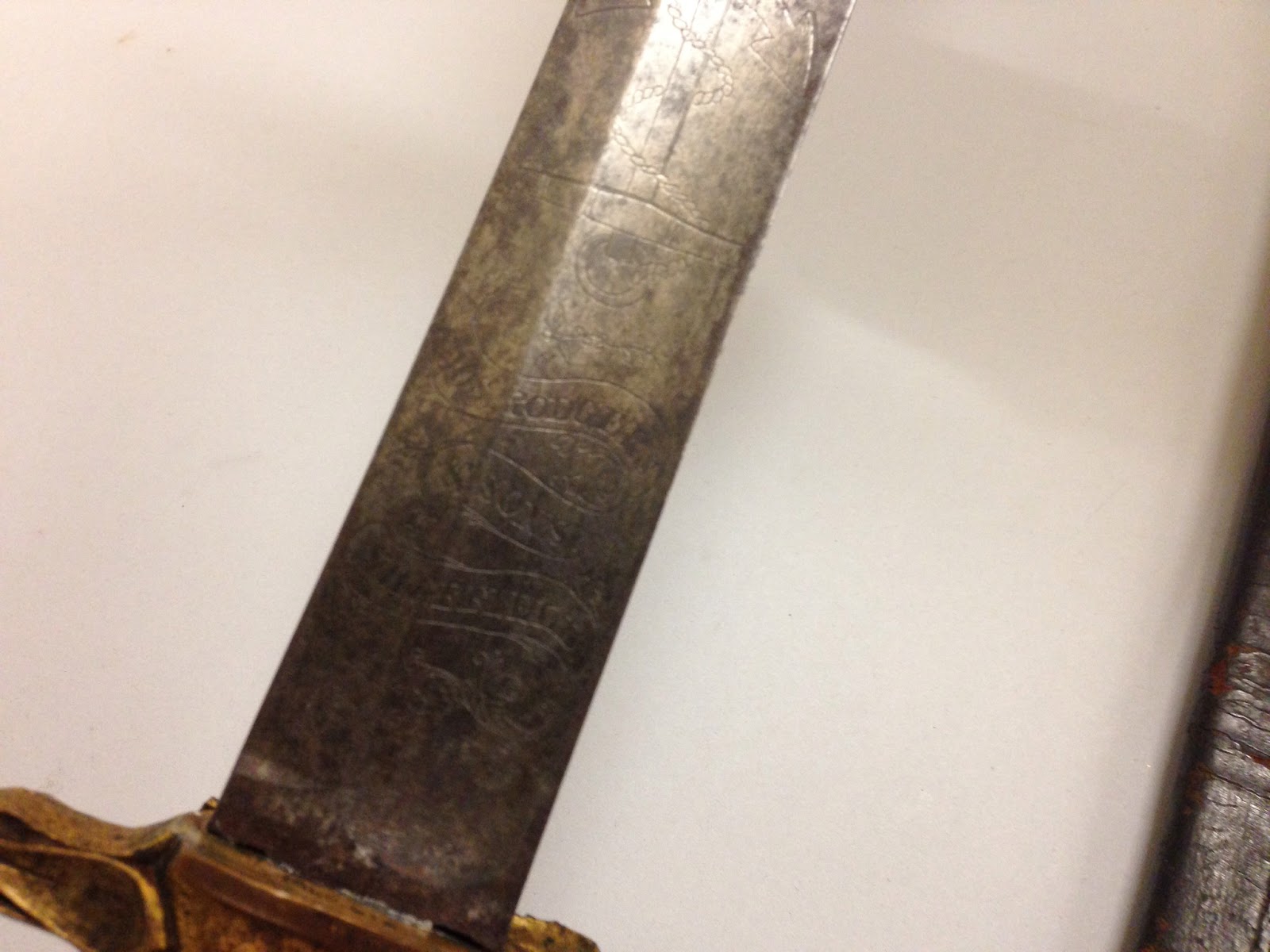
I believe that this sword dates somewhere between 1812-1840, given the style of etching on the blade  and the width of the blade.   The width of the blade suggests to me that this sword originates from a time period when fighting by sword was a likelihood, not just  a possibility.   The later antebellum eagle heads swords appear to me to be for peacetime officers.  Their  as their blades tend to be more  narrow and  they look more suited for the ballroom rather than the battlefield.  The MDAH card references this sword as a pattern 1841 Naval Officer's Sword.  While it most certainly resembles the hilt of 1840s eagle heads, as stated above I believe that this sword is earlier,  also because  of the blade decoration.   The blade is hand etched with anchors and 13 stars in a circular pattern  as well as other military motifs and the style of script more closely resembles that seen on late 18th century and early 19th century swords.    The ornate furniture of its leather scabbard carries the same motif -- anchors and 13 stars.  

The blade of this particular sword is marked to the English cutler Jos. Rodgers and Sons, Sheffield.    Joseph Rodgers and Sons originated in the mid 18th century in Sheffield, England.  While it manufactured swords, the company is better known for its knives, including Bowies.  Jos. Rodgers and Sons remained in business until 1975, but in its later years  making more mundane blades  such as scissors and razor blades.  It is not strange that this sword was made by a. British company for American trade.  For centuries  British, French and German cutlers made swords for export.  Sheffield, England was a center for knife making, much as Solingen,Germany and Klingenthal, France are known for sword manufacturing.   Even after the ugliness of the Revolution, the sabre rattling of the impressment of sailors and the War of 1812, business was still business.

What interests me most  about this sword is how and why it came into the MDAH collection. Of course, donors can given anything they want and not every sword  in the collection has some relationship to Mississippi.   Was it the sword of a Mississippian that served in the United States Navy?  Did a former U.S. naval officer carry this sword when he served in the Confederate navy?    The catalog  card is silent as to who donated this sword and when it was acquired   It sure makes me wonder.............


Tuesday, March 19, 2013

My History as a Collector Part IV

In 1996, my wife and I moved to the Jackson area.  I started a new job.  I also started a new area in militaria collecting.

I had always been fascinated with British military tradition, but new very little about British military weapons and accoutrements outside of knowing that a Brown Bess is a British flintlock musket (little did I know that there are several models of the musket) and the British WWI and WWII era weapons and vehicles.  A new thing, called the Internet, changed all that.   In the infancy of dial up Internet, I found British militaria dealers that listed items or sale.  There were no pictures, only a written description.  Ordering an item was more than the simple click and pay that it is today.  I had to identify an item in which I had interest based upon written description, email the dealer to see if it was still available and, if so, request that pictures be emailed to me. If I liked the item, I attempted to negotiate a better price.  If a deal was reached, then I had to arrange for payment -- an international transaction.  Payment was typically by credit card -- a safer way to operate internationally in my opinion, because all purchases are somewhat insured.  If I didn't get the item, then I could dispute the charge.   Over the years, I became acquainted with one particular dealer in the United Kingdom.   As the Internet progressed, the dealer's  website technology improved and pictures were included with the description.  Pictures made things much more simple.  With this particular dealer, I developed a business relationship from which ensued a typical dialogue. For example:

Me:   Hello, Bob.  Do you still have item no. 354768, British pattern 1845 infantry sword, and, if so, what is your best price?
Dealer:  Hi Andre.  Yes the item is in stock.  Best price is £345 including shipping.
Me:  Thanks.  Let me think on it.
Dealer :  Okay. I'll hold it for you.

In most instances, we reached a deal and in case you are wondering, it takes about a week to get a sword England to Mississippi.   I did purchase from other dealers in the United Kingdom and France, but mainly from old faithful.  I am pleased to say that I never had a bad transaction with this dealer.  The few that I had that were unsatisfactory were rectified to my benefit.  The Internet allowed me to collect European  swords and firearms from the 19th, 18th and 17th centuries as well as a few uniforms and accoutrements.  At one point I had several British uniforms on mannequins in my office.  I'll admit that it was creepy.

The Internet also allowed me to connect with people who share my interest in old guns and swords.  I'm proud to say that I have made the acquaintance of one very knowledgeable people  from all over the world, some of them published authors on the subject of militaria collecting.  The Internet is not all good, though.   It is much easier pass off fakes when the buyer is making a decision based upon pictures.  I have not been immune to this problem.   Let me say that eBay is a great avenue to buy and sell.   It is  the world's largest garage sale, but  it is also a very dangerous place to buy antique militaria.   It was in an eBay transaction that I was swindled.

I have always like heavy cavalry swords, especially those from the 18th and early 19th centuries. Swords with huge, straight blades with basket hand guards that are meant for business appeal to me.   These swords, however, are expensive.     I had 18th century British baskethilted heavy swords and French heavy swords in my collection.  I wanted a German example.  I hoped to find one of the really cool examples bearing some Germanic noble's royal coat of arms incorporated in the hand guard.  I did some scant research to learn a little bit about what I wanted and decided that I would look for an 18th century pallasch--a German heavy sword.   The pattern originates to the to the 17th century, but I had seen  images of 18th and early 19th century German Kuirassiers, heavy cavalrymen wearing chest armour, armed with a pallasch.  I did an internet search,  hoping to find a dealer with a pallasch for sale, but couldn't find one.  I resorted to ebay and found one.  In my exuberance I forgot a cardinal rule of collecting.   You see, Internet buying is the pinnacle of buyer beware.  It should be the mountaintop of caution.   eBay is no different.  I have had numerous great ebay transactions. In all of those I knew what I  was doing.  Here I was in uncharted waters.   I didn't ask the question that my father asked me many years ago, "how do you know that it is real?"   I also forgot the other cardinal rule.  "If its too good to be true, then it is."  What I mean  is the the price was too low for what the item was purported to be.

What I bought came to be known as "the duck sword."   When I finally received the sword, I found that that it had an excessively heavy and inflexible blade.  I knew that something was amiss.  18th century swordsmiths were very good at their trade.  Genuine antique blades are well balanced and quite flexible.   An unbalanced sword is difficult to control.  An inflexible blade will break.  Knowing that an 18th century swordsmith probably would not turn out a product like this, I still rationalized that perhaps this sword was just not well made.  Actually, I had a  feeling that it had been made in either India or Pakistan in the 1980s.   I looked at the prized coat of arms in the guard  and found that it bore a poorly shaped duck with an equally unsophisticated crown over its head.  I did more Internet research, hoping in vain that this ugly coat was the cypher of some minor European royal.  Nope.  Nothing came up.  I ran it past my internet friends.  It was a duck sword.  At least it didn't cost that much.  I was able to return it, minus shipping both ways.

Its been nearly 20 years since I started this phase of my collecting.  I've  collected some amazing things.   No, I have not kept them all.  I've had to sell items to get other items, but I have had the opportunity to study them first hand where many people have only been able to read about them or look at pictures. I guess you can say that I have developed a broad knowledge base.  As my college advisor exclaimed when  he reviewed my transcript with my diverse coursework in history, art history, anthropology and business courses, "sh*t, you a renaissance man!"   Presently, I have returned to my collecting roots, so to speak.  Over the past 5 or so years, I have returned to Civil War collecting, after a brief time collecting WWII German firearms.  In my recent years in Civil War collecting, I've been fortunate to acquire both Union and Confederate swords and a few firearms.    Who knows what I will get into next.   I've always thought that it would be really cool to own a Roman legionnaire's short sword.   Hmmmmmmm....................

Well, that's my story and I'm sticking to it.

Tuesday, March 12, 2013

The Burnside Carbine, Part II


A little break from my history as a collector.  I have received some questions from friends about how the Burnside carbine works.  That being he case, I've taken some photos of my carbine as well as some of a Burnside round that I picked up at a Civil War relic show this past February. Sorry that the pictures are a bit out of order.


This is a picture of the Burnside lock with the hammer at half cocked and primed. It is primed with a copper percussion cap.  Assuming that the trooper was ready to fire, at this stage he would simply have to pull the hammer to full cock, aim and squeeze the trigger. 


This photograph depicts the Burnside breach mechanism lowered with the hammer at half cock. Also depicted is a Burnside round.  The round is unique in its tapered design.   Notice the screw on the side of the receiver and the slanted groover on the breach block.  These were improvements added later in production to ensure quicker loading.  The guide screw ensures that the breach returns to its rightful place in the receiver -- no muss or fuss. 


 This picture depicts and overhead view of the Burnside carbine with the hammer at half cock and the  breach mechanism open.  the trooper would insert the round into the breach.  A small tube in the rear of the breach fits into the an open in the bottom of the round.  The tube at the base of the breach is connected to the nipple. 


Top view of the Burnside with the hammer at half cock and the breach mechanism closed.  This view shows the nipple.   


As I understand, the first model Burnside did not operate with a percussion cap.  Rather, it used the Maynard tape system which had the excellerent to fire the weapon on a roll of thin paper tape -- hence the name.   The first model also had a side lever which operated the breach instead of the lever inside the trigger guard.  Only a few hundred first models were produced and I've not been able to locate a picture of one.    

Hope this answers all the questions that you may, or ever will, have about how a Burnside carbine operates.