Saturday, April 19, 2014

The whistle sword

The history of man is one of progress and invention to suit demand.   Man was cold, so he learned to use fire. Man needed to move loads and travel far, so he invented the wheel.  Man was tired, so he domesticated animals to assist him in work and travel.   Man needs a cell phone that can perk coffee, make poot noises and report the weather in 80  different countries, so he.......Well, you get the picture.  

Historical weapon development follows the same pattern.  Stones and clubs gave way to spear and atlatl. 


Bronze weapons were replaced by iron, which was replaced by steel.  Gunpowder led to firearms which changed the world.  The arms race never stops. He who has the best weapons has the best defense -- as some theorize. 

The 19th century saw much sabre rattling amongst European nations. Smaller conflicts would later cumulate in the fiercest and most senseless of wars, World War One.   This late 19th century arms build up resulted in one of the strangest weapons, to me.  The whistle sword.  


This Prussian cavalry officer' sword, intially developed in 1852 and carried through World War One, serves two roles:   (1) it is the officer's edged weapon; and (2) it is the officer's took with which to signal his troops. 

I do not own one of these unique weapons, but have had the opportunity to view one up close.  It is a beast. 


It is made if steel. The blade is very long and substantial, as would be expected of a heavy cavalry sword.  It's guard is full and provides complete hand coverage. At the base of the grip is a leather finger loop, which is intended to provide the swordsman with additional control over the blade. This sword is not a nimble fencing blade.  I don't really see the benefit of the finger loop, but cudos for the design thought. 

The quillion is the thing of real interest here.  For those that do not know, the quillion is found on the top forepart of the sword's guard. It'll extends out over or upward from the spine (top) of the blade. It's purpose is to stop an opponent's blade from sliding down and onto the swordsman's arm.   On this sword, the quillion is a whistle. 


An officer needs to signal his men in a method that may be heard over the din of battle. Trumpets, bugles, fifes, drums, bugles and whistles were used throughout the ages for this purpose. What is a bit perplexing about this sword is not the incorporation of the whistle, but it's placement.  Bringing it to your mouth, especially on horseback, must have been a challenge.  As stated above, the blade is very long and heavy.  Further, the location of the whistle would require some pretty strange wrist and arm contortion if the officer wanted to keep his hand on the grip while blowing the whistle.  Makes me think that it was probably a better idea to just give the officer a whistle on a lanyard affixed to his uniform. 

Prussia is not the only nation to have this idea.  My online research turned up another whistle quillion sword.  Someone tried to give the utterly useless US pattern 1860 staff and field officer's sword some battlefield value by putting a whistle on its quillion.   


I have placed the Prussian whistle sword on my list of swords to one day acquire. I've seen a few for sale, but not many.  Even with the whistle, I'll pass on the US 1860 staff and field. 

Monday, March 17, 2014

A Non-regulation Staff and Field Officer's Sword

I like non-regulation civil war swords.  I had one of these years ago. It was in bad shape and some fool had spray painted it bronze.  I cleaned the paint off the best that I could, but it was still in bad shape. 

I came across another example offered in an online auction.  I thought about it for a long while, but in the end I couldn't resist. 


The nineteenth century US military was no different than any other nation.  Pattern weapons were the norm, but officers still deviated from the patterns.  Foot officers (captain and below) were required to carry the 1850 foot sword. 

1850 Foot Sword

Some, however, optioned for a more stylistic non-regulation pattern based upon the British pattern 1827 rifle officer's sword.  

British 1827

Instead of the stringed bugle (the symbol of light infantry, jaegers and riflemen), the sword marketed to US Civil War officers has an eagle incorporated into the guard. 

US Non-reg Foot Sword

Versions of this sword are also found with "US" above the eagle.  This sword is not uncommon and is popular with collectors.  A brass hilted version was also offered and is rather rare to find on the market today.  

Staff and field officers (major and higher) carried the longer 1850 staff and field sword or the absolutely useless 1860 staff and field sword. 

1850 Staff and Field

1860 Staff and Field

The 1850 staff and field features a more ornate hilt to denote the officer's elevated  rank. It is also longer than the foot officer's sword, because it's user was mounted on horseback.  The 1860 staff and field is pure decoration.   To me, it is useless to any officer that might have needed a sword for self-defense.  It was popular with Union generals.  I guess I'm not the only collector that doesn't like it. It is easily obtained on the market for a relatively low price.

The sword I purchased is identified in reference books as a non-regulation US cavalry officer's sword.  I think it is more likely a staff and field sword. The blade is just not long enough to be a cavalry sword.   

This sword was made by Clauberg of Solingen. Examples have been found stamped with the mark if the famous New York Jeweler Tiffany & Co.  Along with selling jewelry and fine glass, Tiffany also dabbled in the arms market as a military outfitter to Union officers. 

Clauberg Mark


The blade is nicely etched with ivy, scrollwork, stars and the important "US."

Without the US etching, the sword couldn't be linked to the United States or the Civil War.  The hilt is steel with a two branch guard and a steel backstrap reminiscent of the British 1821 cavalry sword. 

British 1821

The grip on the non-reg Clauberg is fishskin with one main strand of twisted copper wire flanked by two strands of thin steel wire. The sword was carried in a steel scabbard.  

I said at the start of this post that I like non-reg swords.  Part of the appeal to me is that collecting patterns gets to be a bit boring after a while.  I also like the mystic of why an officer would purchase a non-regulation sword. Was it less expensive?  Was he an individualist?  Did he feel more safe with the sturdy steel hilt of this sword as compared to the more ornate, but weaker brass hilt of the 1850 staff and field. Forget the 1860. The guy that carried this sword wouldn't have been interested in that daisy swatter.  Was this sword more fashionable and sold by a upscale retailer like Tiffany?  My sword doesn't bear the Tiffany mark, though.  Maybe this was just the last sword on the rack.  

For the collector, this sword is not commonly found.  When I made my purchase, I only found one other offered for sale online and two last auction sales. There may have been others, but certainly not many more. I also was unable to find any reproductions offered for sale, unlike the steel hilted foot sword which has been mass reproduced for reenactors.  

Monday, January 13, 2014

The Sharps Carbine


Been a while since I've written anything. With the holidays and blah, blah, blah.....oh let's just own up to it.  I've been lazy. 

Now is a good a time as any to write about the Sharps carbine.  The Sharps is the design of Christian Sharp, a Harpers Ferry Armory gunsmith.  It is a single shot, percussion, breach loading weapon.   The pattern began life with the first models rolling into production in the early 1850s.  Transitioning through several patterns, the Sharps carbine's service life extended well past the Civil War with the last models/conversions utilizing a center fire cartridge.  


During the Civil War, both Union and Confederate cavalrymen used the Sharps.  It was so popular and of such good design that the Virginia gunsmith, S.C. Robbins, produced its own version of the weapon -  although of a lessor quality.  


An easy way to distinguish the Richmond Sharps (depicted above) is by its rear dovetail sight.  The original Sharps (depicted below) has a more sophisticated elevating sight. 

The Sharp's is loaded by lowering the lever (which also serves as a trigger guard), thus lowering the breach. 


A cartridge made of a .52 calibre minie ball affixed to a linen or paper wrapped powder charge is next inserted into the breach. 


The breech is then closed by use of the lever.  Closing the breech severs the back of the linen or paper cartridge. The hammer is moved to half cock and a percussion cap placed on the nipple.  With the hammer moved to full cock, the carbine is ready to fire. 

Civil War cavalrymen favored the Sharp's, because of is user friendly nature, rapid rate of fire and dependability.   The Sharp's was also prized as a battlefield pickup, not only for the aforementioned qualities, but also a for a practical reason. Unlike the metallic cartridge carbines of the era, the Sharp's round is uncomplicated to manufacture.  Thus Southern arsenals were able to produce it making the Sharp's a more useful captured arm than its more complicated cousins. 

The weapon pictured in the top most photo is my Sharp's carbine. It is a New Model 1863 carbine.   Earlier models are found with brass patch boxes in the stock.   With is popularity and long service life, the Sharps is readily found on the market at reasonable prices.   However, please note that the weapon has been mass reproduced   Beware of modern replicas.  

Sunday, December 1, 2013

The Ames Naval Cutlass


It's easy to forget the important role that navies played in the American Civil War.  Ask the man on the street if he has  heard of the Battle of Gettysburg and his answer most certainly will be in the affirmative. However, ask the same person what he knows about the naval engagement at Memphis or the Battle of Mobile Bay.  I'm not certain that the man on the street, unless he is a Civil War buff, will know anything about them.  The United States Navy played a major role in Lincoln's war plan.  Without it, the Anaconda Plan (squeezing the Confederacy to death by stopping its supplies) would not have even come to reality.  The US Navy's Blue Water (ocean) Fleet was called upon to blockade the CS ports and prevent the South from receiving supplies from Europe.   Without the US Navy's Brown Water (river) Fleet, U.S. Grant's plan to take Vicksburg would have been dramatically altered and, perhaps, unsuccessful.   It cannot be denied that the US Navy provided valuable service during the Civil War. 

As with those of the land forces, naval battle tactics in the mid 19th century had been altered by technology.   Steam engines and improvements in the range and accuracy of artillery and small arms changed the way that navy's fought.  For the most part, gone were the days of swashbuckling boarding parties.  Still, navy's armed sailors to prepare to defend against and repel boarders. For centuries prior to 1861 sailors fought with a short edged weapon known as a cutlass.  During the Civil War, sailors were still issued this weapon. 


The weapon pictured above is a US Model 1860 Naval Cutlass.  This example was made by the Ames Manufacturing Company of Chicopee, Massachusetts in 1863. Like all cutlasses, it is short-bladed as it was designed for fighting in the close quarters of  ship. A sailor swinging the 24.5 inch blade is less likely to catch same in rigging and on other shipboard obstacles than he would a longer blade.  The sheet brass handguard provides him with excellent hand protection as it covers entirely the leather and twisted wire grip. It was once housed in a leather scabbard secured to the sailors belt by a loop. 


This sword is not pristine. Like I have stated before, I don't like pristine antique weapons. Rather, I prefer those that have some history.  This sword was issued. It bears a rack and sword number hand etched on the inside if the guard.  Unfortunately, these numbers do not tell us to which ship it was issued. 

The sword's blade is darkened with age and it's metal is mottled with rust pitting. At some point in history, the tip of its blade was broken and a new point reformed -  perhaps by the ship's armourer.  

I bought this sword earlier this year. In the past, I really haven't had much interest in Civil War naval weapons. However, I have always liked this pattern, because it was designed to be used in combat. In other words, this sword is not a dress weapon.   It is my first naval sword and honestly has spurred an interest for me in the subject. 

I want to provide a few notes for the amateur collector. The pattern 1860 cutlass is readily available on the market at reasonable prices.  Most originals have banged up guards and are missing their leather grip covers and wire wrap.  Examples with clean blades command higher prices.  Examples with original scabbards are less common, but can be found.  Due to the rarity of the leather scabbard surviving, complete examples  obtain much higher prices.  Beware that this sword has been mass produced. Based upon my own examination, in general, of antique swords and reproductions, I find that modern reproductions have  heavy, less flexible blades and modern brass is more yellow and thicker that that of an original. Given the extent that this sword has been reproduced, I recommend that the novice avoid buying through an online auction. Instead, the novice should purchase from a reputable dealer who guarantees authenticity.  


Monday, November 11, 2013

The British Pattern 1796 Light Cavalry Sabre


The British 1796 light cavalry sabre is a cutting and slashing  weapon, pure and simple.  Designed by John Gaspard le Marchant, the weapon was mass produced and  issued  to all British light cavalrymen (hussars and light dragoons) as well as horse artillerymen during the Napoleonic Wars. It's form was copied and used by the fledgling United States for its Dragoons.  It was likewise copied by the Prussians for the pattern 1813, or Blucher, sabre.   The sword remained Britain's  official pattern until it was replaced in 1821 by a completely different form.  However, it served on in India with native cavalry and police units throughout the 19th century and into the 20th century.  The Blucher sabre was carried through the end of the First World War. 

The hallmark  of the 1796 LC is its broad, highly curved 32.5 - 33 inch blade.  The blade, which bears one large fuller, widens to a hatchet shaped point.  For hand protection, it has a single branch "P" shaped guard.   The pattern's grip is comprised of a wooden core over which cord is wound with a leather top-covering.  The pommel assembly incorporates a steel backstrap across the top of the grip with two "ears" issuing downward midway on both sides of the grip.  A steel pin through the grip connects the ears, providing for a strong union of the assembly.  The hilt also incorporates shield shaped languets protruding down  both sides of the blade.  


The scabbard is steel with two hanging rings and a very subtle drag, or shoe -- meaning that is not very pronounced from the bottom of the scabbard.  Swords are often found marked with the cutler's name in the spine of the blade and/or the inboard and uppermost panel of the scabbard.  Swords accepted by the British Board of Ordnance have inspector's stamps in the blade. Regimentally marked 1796 LCs, both regular and yeomanry, bear markings on the top of the quillion or the knucklebow and on the scabbard.  Unmarked examples and plentiful and it is not uncommon to find swords and scabbards mismatched. 

Officer' swords may be distinguished by etched blades, the finest of which are blue and gilt. Examples are found  slightly smaller and there is a wide variety of pattern deviation.   The officer's grip is typically shagreen with twisted silver wire. It may have backstrap ears, which are usually smaller and more decorative, or none. 


The sword depicted below is one that I found in a relic shop outside the Chickamauga National Military Park.  As found, it is a example of what not to do to an antique sword.  


Mixed with US Civil War swords and muskets displayed for sale, I spotted the sword hanging on the wall.  It was shiny; far too shiny than any 200 year old weapon ought to be. I asked the store owner if I could see the 1796 sabre hanging on the wall.  As Napoleonic sabres have little interest to the Civil War enthusiast clientele which frequents his shop, the owner was surprised that I new what the sword is. Upon examination, I found that some fool had cleaned the sword and spraypainted the hilt and scabbard silver. The shop owner said that the previous owner told him that this fellow promised to make the sword look brand new.  Ummmm.....why?  It ain't new. It's 200 years old.  I ended up buying the sword at a very fair price given it's condition. 

I normally do not advocate cleaning any antique arm outside of routine conservation -  remove active rust, dirt and grime; restore and protect leather.  Do not remove patina.  Patina is age. It is part of the weapons history and should be left alone.   However, the damage had already been inflicted on this sword.  

I started by removing the paint to the best of my ability.  This required steel wool, lacquer thinner, arm fatigue and, unfortunately, stronger chemicals. After I was down to a cleaner surface, I used WD40 and steel wool to try to remove the haze left by the chemicals. I was not pleased with the finish, so I darkened the metal with several applications of black show polish over a few days.   The result was as good as I could get it.  


I wish that I had before photos, but I did not think to take any.  It didn't turn out perfect, but the sword sure looked better than it did before.  Make it look like new? Pleeeeze. 

A few parting words on the 1796 LC for the potential collector.   With all of the variations, a whole collection may made of this pattern. Examples are found relatively inexpensive, but you get what you pay for.  Make sure that what you are getting is an original 1796 LC.  This sword has been mass reproduced by modern cutlers for sword fighting enthusiasts and by Pakistani exporters for reenactors and collectors of reproductions.    Beware of Bluchers being passed off as British swords. The knucklebow and the scabbard shoe of the British sword are more subtle than those of the Blucher.   Also, note that a 1796 LC with a brass guard with a British cutler's name on it was probably made for export to the United States -- but not, as some would contend, for the Confederacy.  These swords were made long before the Civil War. 

As stated above, the 1796 LC served in India for a considerable time after the Napoleonic Wars.  If you think you are purchasing a Napoleonic example, but the sword bears Indian, Pakistani or Nepalese markings, think about it.  There is nothing wrong with buying an example made for American export, a WW I Blucher or an Indian police unit marked 1796, unless you think that you are getting a Napoleonic era British 1796 LC and paying the price for it. 

Thursday, October 10, 2013

A Napoleonic Era Light Cavalry Officer's Sword

Last weekend,  a friend gave me a tip about some swords that she saw at an estate sale.  Typically, estate sales have not yielded many antique arms for me.  When, infrequently, antique guns and swords have been included in an estate sale, the specimens are usually not as described.  Face it, most of the companies that manage estate sales do not have workers who specialize in antique arms.  Often, when there are antique arms included in an estate, they are sent off with dealers or placed in specialty auctions for sale.  So, when my friend told me about three swords that she saw, I was a bit of a Doubting Thomas. 

Curiosity got the best if me.  My friend gave the number to the sale location and I called to inquire about the swords. Naturally, the person with whom I spoke knew nothing about swords.   I was told that that the swords were all from the Civil War. I asked some rudimentary questions and gave my thoughts on what I thought they were.  

The first sounded like an 1860 staff and field officer's sword. Nope.  Not interested in that one as it's a dress swords.  I don't like dress swords. The second sounded like a run of the mill 1840 heavy cavalry sword. Not really interested in it for my collection, but maybe for resale if the price is right.  The gentleman really could not describe the third one. He said that it was "fancy" and that the blade had some scrollwork.   I asked for pictures  and he agreed to send them. I asked the price. He wanted the same price for each sword, which per sword was not shockingly high or low. The asking price seemed to be good, but the gentleman said the magic words, "we are negotiable."   My interest level increased. 

While all this was taking place, I was at a craft show helping my wife with her booth. I was on the other side of town from the sale and needed to pick up our daughter from dance practice soon.  I decided to take a chance and go to the estate sale.  I picked up my daughter and informed her that we needed to run a quick errand.

I received pictures of the swords, but they didn't really tell me much.  Arriving at the sale, I asked my daughter to stay in the car. "This won't take long," I said. 

I went in and immediately found the gentleman who sent me the photos.  I was right about one sword  -- a US 1840. No makers marks, but it had its
scabbard.   If I could get it for the right price, I would buy it for resale.  The next was not an 1860 staff and field, but rather an 1840 NCO's sword. It lacked its scabbard, but was marked to a good maker. It was also overpriced, very overpriced, and I had just purchased another example during my recent trip to Chickamauga National Battlefield. Hence, my interest in the sword was negligible.   The third sword was clearly not of the Civil War vintage -- from an earlier era and I was very interested.  

I made an offer for all three -  a lowball price.  My salesman told me that he had to check with the manager.  He returned with a rather unfriendly looking woman who said "I'm not dealing today. You can come back tomorrow."   I told her that I was not coming back tomorrow. She had a cash offer and should consider it.  She said again, "I'm not dealing today.  You can submit a bid and we will consider it tomorrow."   "Nope," I said, "I'm not coming back down here tomorrow."  She was unrelenting, so I told her "oh, well," and asked that she please not offer the third sword as Civil War, because the description is blatantly untrue.  As I walked off,  the gentleman apologized to me and urged me to make an offer.  It was me this time that was unrelenting.   

I walked outside, got half way across the street and turned around.  I wanted the third sword. I walked back in and paid the asking price for it. I passed on the others. 

So what did I buy?   I'm not exactly sure.  I know that it dates from anywhere between 1790 and 1830 based upon the style of the hilt and the etching.  Beyond that, I don't know what it is, but I like it. 


The hilt is strongly French influenced. Based the shape of the hilt, lightness of the blade and the fact that it is etched, this is a light cavalry officer's sword. 


As I said, the etching dates the sword to the late 18th to early 19th centuries.   Blades of that time period are often found hand etched with flowers, stands of arms and banners.  The blade of my sword was at one time blued and the etching gold filled.  With it's gleaming brass hilt
and vibrant blue and gilt blade, it must have been something to behold. 

From where was the officer who carried this sword from?  I've seen the same etching hundreds of times on blades from Solingen.  The German cutlers in Solingen cranked out thousands if blades for export in the 18th and 19th centuries. The Germans sold to everyone. Even officers of the Napoleonic super powers, England and France, carried Solingen blades.  The etching style, being common, doesn't answer the question.  


My sword certainly resembles the French First Empire An IX light cavalry sword and it's russian counterpart.  It hasna three branch guard, a pronounced, curled  down quillion and diamond shaped languets (protrusions from the guard over the blade the purpose if which I have heard ranges from securing the sword in the scabbard to trapping and breaking opponents' blades).  


It's not exactly the same though.  My swords pommel is different.  In fact, the pommel looks British to me - like the 1821 light cavalry sabre. 

Maybe it's a Bavarian cheveaux-leger sabre, also known as the Rumsford sabre. 


Again, it's just not exactly the same. The Bavarian sword's hilt is more box shaped and, as with the French/Russian swords, the pommel is different. 

What makes identifying mybsword to a particular pattern and nation more difficult is its status as an Ifficer's sword.  Officers had lead way to individualize their edged weapons.  It could me any if the above -- stylized by the particular officer. 

So, for right now this is a Napoleonic era continental light cavalry officer's sword.  I can live with that.  At least until I get some more information. 

Tuesday, September 24, 2013

The CS Howitzer


I have a fondness for Civil War artillery pieces.  I don't know what it is that draws my attention.  For the most part, they all look alike.  Typically, there are two wheels, supporting a carriage upon which the barrel, or tube, is mounted.  
The best place to view Civil War artillery pieces is at our national military parks. Cannon in private collections are few and far between.  Cannon at national military parks are readily found dotting the battlefields on the ground where artillery units  served. 

CS battery site, Bragg's Headquarters, Missionary a Ridge, Tennessee

Up close, it is easy to distinguish the differences between field pieces.  There are smoothbore guns made of bronze, iron barreled rifles, rifles bearing a reinforcing band in the breach (Parrott rifles), squat mortars, large siege guns and rifles and coastal artillery of all sorts.  As securing ownership of an original field piece is incredibly difficult given the relative scarcity, not to mention quite expensive, we are fortunate that these artillery pieces are in our national parks for the public benefit.  
CS Battery site, Lookout Mountain, Tennessee

Union battery site, Chickamauga National Military Park.

Union battery site, Grant's final line of defense, Shiloh National Military Park, Tennessee. 

Union battery site, South Loop, Vicksburg National Military Park, Mississippi. 


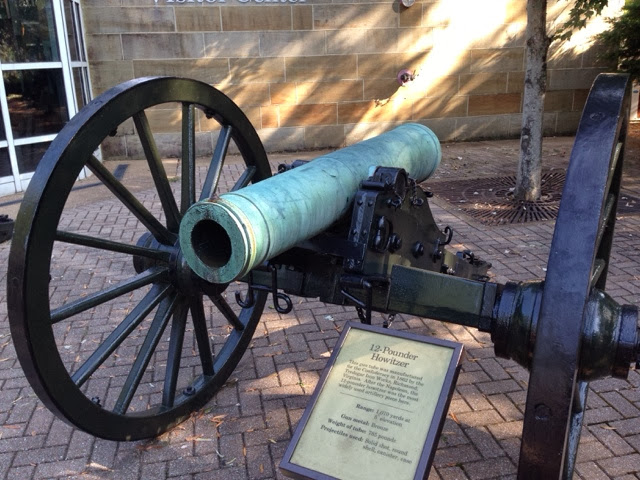
I recently traveled to Chattanooga, Tennessee with a  good friend to commemorate the 150th anniversary of the Battle of Chickamauga.  In front of the Visitors' Center, I found an array of field pieces including a short barreled howitzer.  Obsolete by the time of its manufacture, this 12 pound smoothbore gun (based upon the weight of its ammunition) was poured at Richmond, Virginia's Tredegar Iron Works in 1862.  


Founded in 1837, Tredegar rose to become a large metal goods manufacturing center by 1860.  During the war, Tredgar manufactured metal goods ranging from artillery tubes to ironclad warship armour for the Confederacy. 


The foundry's wartime director, Joseph Reid Anderson, acquired the facility in 1854. The mark of his company, Joseph Reid Anderson & Co., is found on the trunnions of Tredegar tubes as "J.R.A. & Co."   Such mark is found on the Chickamauga howitzer -  if only my picture had turned out!

As opposed to long tube rifles that soon projectiles on a flat trajectory towards a target, howitzers are short barreled, smoothbore guns that lob projectiles high into the air.  They are effective weapons for sending shells (artillery rounds that explode above the target and scattering shrapnel) high into the air and grape or canister (shotgun shells for artillery that pour metal balls or scrap metal into the enemies ranks) into massed infantry and cavalry. Howitzers and other smoothbore were well suited for battlefields such as Chickamauga which are marked by wooded terrain separating open fields. 

There were other southern foundry's manufacturing cannon during the war.  Cannon are found at national parks marked to manufacturers from cities such as Memphis, New Orleans and Atlanta.  I have even seen  an artillery piece at Five Forks, Virginia, marked to a foundry in Vicksburg, Mississippi.  While northern made  cannon existing today greatly outnumber the southern made counterparts, I applaud the National Park Service for placing Confederate guns and rifles at places where Confederate batteries were in action.  The dedication to historical accuracy is impressive. 

What of Tredegar Iron Works?  Richmond suffered during the late war years and the once third largest American metal foundry suffered damage as well.  Its remains, however, preserved as a historic site which offers a glimpse into 19th century technology and wartime manufacturing.